Thursday, October 23, 2008

Lost in a Good Book - Jasper Fforde


Spoiler alert;
This sequel to The Eyre Affair picks up with Thursday and her incredibly easy transition into marriage and her ridiculous life. There is more craziness and then the book falls into what many sequels fall into, which is the hideous plot where everything rains shit (to take a Wayne's World phrase) on the main character. She loses her husband, she loses everything and the world is going to end. Literally. Most of the book is spent in agony where everything just sucks. Despite this, the book is really quite fun and imaginative as it delves into book traveling and lots of adventures.
Total fluff and frustrating, but like Harry Potter, there is always more to come after the ugly petty juvenile stuff, that is tons of fun.

Three mastodons out of 7

Andrew

Monday, October 20, 2008

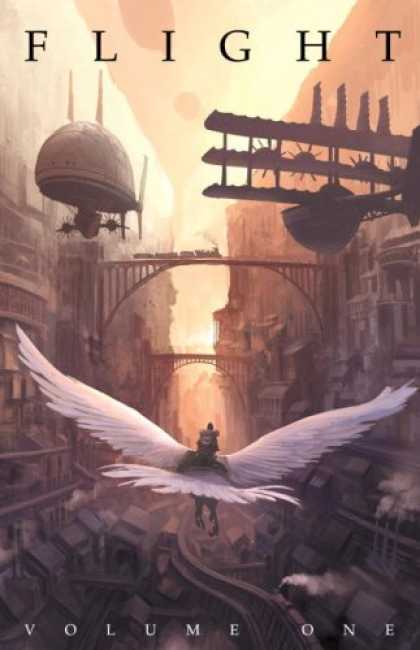
Flight - Ed. Kazu Kibushi


The Flight series is a compilation of little known authors and artists who write these very short stories that can be delightful or sometimes annoying. They are said to be loosely based on the theme of flight, but I would argue that it is instead simply about things that are wished for and seemingly unattainable. The idea that someone would say that they wished they could fly, that's whats captured in these books. All those childhood visions of alternate realities and super powers and strange delightful creatures... all of those are caught up in these books. I agree some of these stories can miss the point entirely and be quite trite and immature, but others can have you lost in distant imaginary lands for hours galavanting and enjoying. This isn't really escapism either, but really just an acknowledgment that these sought after dreams are able to be enjoyed even if the laws of physics say they aren't.
A great read for anyone who wanted to leap over tall buildings or meet a polar bear or just play a lot.
five 1960's futuristic steampunk cities out of five.

Tuesday, October 14, 2008

The Eyre Affair - Jasper Fforde


The Eyre Affair is one of those silly little airy adventure books that are so hard to put down. After finishing it, I'm now reading another mystery type novel and having a hard time with it because it takes itself so seriously. The Eyre Affair has some problems with it, for instance characters are awkwardly added or moved around without explanation for the furthering of the novel. Not that characters can't be added, but in one scene, a character comes up to the protagonist, says hello and then walks away, then the protagonist has to walk over to him and then start talking to him. There are awkward instances like this throughout the book and I give a little cringe every time it happens but then I move on and enjoy the book. The book also succumbs to the time old problem of fantasy novels in that it has the protagonist do bad ass things just because its not like back here in boring old reality. The protagonist in this case, saves the world from a time rift just so that the author can put a cliff hanger at the end of the chapter.
Anyway, the book is a great beach read and is perfect if you've been having a hard time finishing a novel lately. Plus its a series of three or four so I've got lots more reading to do once I can actually find the other books.

4 Dodo's out of 5

Andrew

Thursday, October 09, 2008

Transmission - Hari Kunzru


This is a story by a British man from India and I highlight that because I haven't liked a book from India in a while after reading A Fine Balance and loving it so much. Everything seemed to just follow in its footsteps or be too close to impressing Oprah. Anyway, this isn't written by an Indian, but by a Brit with Indian background.
There were in fact many nice moments throughout the book where I thought that the character development was alright and you really got into it, but the main drawback I found was something I've encountered before when author's use the literary device of writing in flashback. This book spent so much time talking about current events as if they were past tense that it made it seem like it was leading up to something and when that lead up finished, it was ultimately quite disappointing. Disappointing like Oldboy disappointing. Anyway some of the computer stuff was kind of fun and bewitchingly simply and sexy but overall the characters were unbelievable and the "romance" of the story was only apparent by the fact that it says that its supposed to be a romance.
The writing style manages to make it at least readable but honestly, I'd just skip it.
Four trojans out of 10

-Andrew

Wednesday, October 01, 2008

Catcher in the Rye - J.D. Salinger


I'm so glad I didn't read this in high school. I got very little from any of the books that I was forced to read and this would have been a horrible one to miss. It is quite similar in many ways to Mordecai Richler's Appreticeship of Duddy Kravitz but differs in a number of ways. The foremost similarity is that both have a very low estimation of human life and a somewhat pessimistic tone while trying to show that while everyone feels their life is hard, if you look at it from the outside, its really not that bad. The difference I would say is the Duddy is an ass and I didn't like him and am not surprised in the slightest that he has a hard time with life, whereas with Holden, the protagonist of Catcher, is a smart and thoroughly good character who is simply caught in the cycle of teen depression and angst. Not that that makes it any less valid, in fact as a stereotype, it gains power in that everyone goes through it. Of course everyone goes through teen aged years differently but they all have a hard time, even the popular kids have their own problems.
Read it and be a better person because of it.
6 fields out of 7

The Glass Castle - Jeannette Walls


I haven't encountered a book this moving in quite a while. The reason being, of course, that it's true. The characters in this book are so rich and real and powerful and sad but most of all they actually existed. This is the story of a young girl growing up with parents who don't like to live the way everyone else does. The sheer ingenuity and inventiveness that is displayed by the parents is only matched by their absolute lack of responsibility and connection to the world. I've met people like this and I actually want to meet more because as hard as they are to be around, they are just ridiculously inventive and creative. These are the crazy artists who berate everyone and yet make the world a better place some how. I was just blown away that the entire novel, I spent my time wanting to meet these people just because I think I could tap into their inventiveness without being taken down by their negativity. I think the only solution is to be more creative myself.
The book shows the narrators family as tenacious, durable, and self sufficient while allowing them their faults and showing their regression down into wasted time and alternate lifestyles that are painful to read sometimes but so worthwhile.
Just check it out because its amazing.

10 out of 10 desert travels.
andrew

Monday, August 13, 2007

Death Before Dishonor, 50 Cent & Nicky Turner

This is pulp fiction at its worst.

I had to read it. Toronto's lit geek community is all over the series as surprisingly funny beach reading, and I'd have to agree with them. It reads like a bad book geared toward grade 6 kids. Some of the writing literally makes you cringe.

The storyline is pretty basic: gantsta finally finds a bitch who gives him a run for his money, they fall in love, mess with a local drug lord and have to pay the price. Throw in some pimped out rides and a helluva lot of bling and there's the book.

It is also filled with life lessons. For example, when dressing to impress, choose chinchilla and mink furs. Accessorize. If your car is blue, buy a suit, cane, and hot twins wearing blue contacts to match. If you see a new Hummer, chances are it'll have a secret compartment for drugs and/or guns. Don't date gold diggers; they'll sell you out for a little cash.

To get all the entertainment value out of this baby, you have to embrace how terrible the writing is. It's well worth the effort.

3 gangstas out of 10

Steph

Thursday, August 09, 2007

The Queen's Fool, Philippa Gregory

Set in the mid-1500s, The Queen’s Fool follows a young girl, Hannah though her service in Queen Mary’s court. Hannah and her father have fled to England from the Spanish Inquisition, guilty of their Jewish ancestry. Shortly after they arrive, masking as reformed Christians, Hannah is discovered by a Lord and his tutor as a holy Seer, and they see her hired as the royal fool. Her job is to say what she thinks, tell of her visions, to inspire and amuse the Queen. In court, Hannah finds herself drawn into the confidence of the lord who discovered her, the queen, and her step-sister, all of whom have conflicting interests. Meanwhile, her father and husband-to-be have their own opinions of how she should be employed and to whom she should be faithful. She is forced to balance her obligations to each, while ensuring that her past is not discovered.

I’m going to employ the sandwich technique of praise, criticism, praise:

I really enjoyed the fact that Gregory didn’t allow Hannah to always follow what the reader wanted her to do. It would have been easier to tie it up halfway through with a bow, but taking the harder route made for a much more gratifying read.

About 2/5 of the time I was reading it I remained mildly frustrated with how slow the story moved, how repetitive the wording was and how certain thoughts or words were not in keeping with the time period of the novel. The trouble is that this was written in bite-sized pieces, structured like a Hardy Boys novel, where details are repeated for the sake of those readers whose attention has drifted or who haven’t picked up the book in days. For a historical novel, it could have gone into more detail about the history.

That said, the romances were highly entertaining.

5 of 10 white horses

Monday, August 06, 2007

The Kite Runner, Khaled Hosseini

This is one of the most heart breaking novels I have ever read.

Amir, 12 when we meet him, lives in Afghanistan with his wealthy father and their two servents, Hassan and Ali. Amir and Hassan grow up together but find it increasingly difficult to remain friends, Amir being Pashtun and Hassan being Hazara. Amir is eventually forced to choose between protecting himself or Hassan and their friendship. At the start of the Soviet invasion, Amir and his father flee to California. Years later, Amir is called back to Afghanistan to help make amends for his past.

This novel helped put into perspective the past few decades of Afghan history. If only for that I would recommend it. But Hosseini's characters are so wonderful as well. I suspect that most people see a bit of themselves in Amir, both as a young boy and as he matures. I hope that when I reread this book in a few years time, I will see more of myself in Hassan.

My next project, after my current book is to read Hosseini's second novel, A Thousand Splendid Suns.

8 kites out of 10.

Steph

Sunday, July 29, 2007

Harry Potter and the Deathly Hallows, J.K. Rowling

Are you surprised this is in here? You shouldn't be.

I'm not entirely sure where to start because, as always, I read this book at whirlwind speed, sacrificing sleep to finish it. And while this technique quells my need to know exactly what happens now, it isn't quite as useful for reporting back on the specifics.

I think the first book will always be my favourite, if only for its novelty, but this is probably second. I really don't want to say anything more about it. Harry Potter is so publicized and so personal that it wouldn't really matter anyway.

Steph

Robinson Crusoe by Daniel Defoe, Part I

I tried to read it. I really did. But it's taken me so long to get to page 90, and so much frustration because I'm not committed to Crusoe as a character, that I can't finish the book right now.
That Crusoe is ingenious in his design of his camps and producing various crops is marvelous and I always get excited during these descriptions. But apart from these, I found the pace of the novel maddeningly slow.

I'm sure in the future I'll pick it up and the story will resonate in a way it didn't before. But for now I'm going to have to accept that reading novels is only helpful if you take something from them.

I can't even rate it yet. You'll have to wait for Part II for that.

Steph

Monday, July 23, 2007

Alice's Adventures in Wonderland, Lewis Carroll

What a wonderful bedtime story.

It has to have been at least 13 years since I’d read this last. And even though I was obsessed with the TV version (Irwin Allen’s 1985 gem), I found I’d forgotten a lot of it. For example, Tweedle Dee and Tweedle Dum don’t appear until Through the Looking Glass, which is another post entirely.

I think everyone should read this again as an adult. It’s still as wonderfully funny and whimsical as you remember and even better now that you know why the Mad Hatter is mad.

You know, I was about to write a beautiful, eloquent blog about this novel, but my family is discussing the intricacies of removal of varicose veins (slice above, slice below, fish out offending vein) and I’m quickly becoming sick. So I’m going to have to leave it at that.

4.5 hair ribbons out of 5. It would have been 5 of 5 had I been born at a time when the rhymes in the book were still being taught and I understood more of it. Though of course that's my fault, not Carroll's.

Steph

Friday, July 20, 2007

Anthem - Ayn Rand


This was a rather hard book for me. It reads easily, and it's only really about 70 pages long, but my problem was with its politics. You see, Rand was a staunch capitalist and she puts forth a brilliant argument for capitalism as being a form of individuality. Thats what the dust jacket says anyway. The truth in my mind is that Rand was arguing only for individuality, not for capitalism at all. Rand see that there is a huge amount to hide behind when the word "we" is used. It makes fools smart and the cowardly brave. Intellectually, this is entirely correct and I agree with her entirely that in the academic world there should be a struggle to be the best yourself, without relying on other people for your intelligence. Economically, I disagree entirely but that really isn't the point of this book. I think that it has since been construed to being a capitalist book by a bunch of capitalists who want to justify their existance, but in reality, this is just a book about not letting the man get you down and homogeonize you until you can't use your brain to the fullest extent of its capabilities. Not letting yourself getting caught up in the lie of "we" so that you never produce anything yourself.
I would definitely recommend this as it really can be read super quick and you get a lot out of it. I would be interested in reading her other works if they were 7gazillion pages long. I'll have to eventually I suppose.
Good readin.
Andrew

Water For Elephants - Sara Gruen

A very simple and fun book about the circus. It really seemed to me like the writer did it just kind of like a newspaper article. She wrote it very acurately, made sure to get the emotional hook in, but didn't have any real substance in my opinion. The basic premise is that a young man runs off to the circus, crazy, fun antics ensue and then the other half of the book (intermingled) is spent reminiscing about his time in the circus as a 90 year old. I think the most interesting part about the book is this commentary on life as a series of memories which lose value the more aged they are. Very entertaining and simple book that is a really easy read but it was too much of a cut and dry, obvious attempt at writing a book club novel. She even had a list of book club questions that could be asked at the end. Seemed like a lady that has had a really simple, secluded life sitting in her friends living rooms and talking and finally deciding she should write a book to make a few bucks and a name for herself.
Fun to read but don't expect more than a simple narrative.

Andrew

Englsih Passengers - Matthew Kneale

This book reminded me a bit of Cloud Atlas in that it is a pretty complete romp over a huge amount of distance (and pages) but the comparison stops there. This book has a rather simple theme where as Cloud Atlas I still havn't totally figured out. English passengers is a book about racism, colonialism, and the prejudices of science and religion. Very interesting book with clear but sweetly paradoxical morals that are really quite enlightening. The real fun in the book is that its about a huge journey across the world in the time of pirates and "savages" and excitement. This book is great for someone who loves adventure but also has a proper conscience or at least cares about other people to the slightest extent. Great to see a book that deals with Tasmania and the extinction that occurred there.
One of the most interesting couplings is between a priest and a scientist who are both totally self righteous and enormous jerks. Hard to read because you hate them so much but it makes you think of how people think when they're commiting attrocities. A few other characters give a really interesting tinsight into how westerners think when they're helping the "less fortuneate."
Recommended for someone who has a lot of time, especially if they're currently on a boat. At 500 pages its not for the faint of heart.
not blow away but enjoyed reading it for sure.

Andrew

Thursday, July 19, 2007

The Fabulous Girl's Guide to Decorum, Kim Izzo & Ceri Marsh

I truly think everyone should read this, not just fabulous girls to be. It's quite literally a guide to navigating every day in a positive, productive, and of course, polite, manner. And who doesn't need that?

With chapters on the workplace, friendship, and dating, this book covers everything from dealing with nightmare bosses to how to ask for a raise, from what to do when a friend is being cheated on to handling toxic friends, from what to serve sleepover guests for breakfast to how to tell them you're just not interested. All, of course, while being perfectly considerate.

My favourite feature is the lists of wardrobe, bedroom, kitchen, and bar necessities (bar: whiskey, red vermouth, white vermouth, vodka, gin, angostura bitters, brandy, red wine). Especially when you're young and money is tight, it's great to have an idea of what purchases will carry you through until your bank account expands.

Let me dispel any notions of this book being full of shallow self-help tips. I guarantee you will learn a thing or two about how to conduct yourself. And at some point, when you find yourself in a tricky situation, you'll be glad you read this.

Four and a half martinis out of five

Steph

The Talented Clementine, Sara Pennypacker

I started reading this to my 8-year-old cousin last night and had to borrow it to read it all the way through. It might have taken me half an hour, but it was half an hour of trying desperately to muffle my laughs, trying not to wake anyone else in the house. Because Clementine is beyond hilarious. She's mad that her parents named after her a fruit, so she never refers to her 3-year-old brother by his name, only by vegetables, which, she thinks, are the only names worse than hers. Also, she names her cats after bathroom products. Somehow Sara Pennypacker has taken that kid we all pretended we weren't - the one with leaves in their hair and two left feet and zero ability to concentrate in class - and made a hero out of them. Which is pretty freaking fantastic, if you ask me. My cousin thinks so too. He's adopted her speech patterns.

This is the second (and sadly, last) of the Clementine books, which means I'll be picking up the first book at the library today and won't get anything else done until I've read it. I really can't say much more about it, so I've included an excerpt from it. Don't worry, it won't ruin it for you. You should absolutely read it.

"Juggling was a good talent...
"Luckily, I found everything right away. My mom's pocketbook was right on her drawing table, and next to it was half a cup of coffee. The phone was under my bed - probably String Bean left it there, because I'm sure I didn't. Then I found Moisturizer and scooped him up.
"Okay, fine, a kitten isn't the same as a poodle. This is called Making Do.
"Let me tell you, it's pretty hard just holding all those things at once. And before I could toss everything into the air and start talking on the phone, Moisturizer saw a bird outside the window. He jumped out of my arms, and everything else crashed to the floor.
"And then I learned the difference between crashed and smashed: crashed is easier to clean up. Also, I learned that coffee is easier to clean up when you spill it on a new brown rug. You hardly have to touch it at all!"

As far as kids' books go, which I am already quite fond of, this is for sure 24 bottle caps out of, well, 24.

Steph

Thursday, July 05, 2007

James and The Giant Peach - Roald Dahl


Roald Dahl is the greatest children's writer of all time for two really solid reasons. Reason the first, he has the greatest imagination of any adult I have ever encountered. His books are simply so wonderfully fantastical that there is no comparing them to anything else. They seem to be imbued with a silliness that mocks the serious fantasy novels that should really just be playing.
Reason the second is that he's pure badass. People die in his books. Like actually just die instead of the disney version where everyone lives happily ever after. Here some people live more happily after others have died. Dahl was a fighter pilot in the second world war and I would think that his close experiences with death taught him how simply unavoidable it really is.
Dahl's books are fantasy but they paint a more accurate world than conventional fantasy does. Dahl even swears in his book (not badly) but he seems to be part of the last generation who thought that kids didn't need to be sheltered, but instead educated and taught how to interpret the things that they read.
I love all the books I've ever read by the guy and I think that absolutely everyone would gain something by reading even a page of his prose. Quick read too, only about an hour or so.
9 centipedes out of 10. Good book. Read it.
Andrew

Wednesday, July 04, 2007

Freakonomics - Steven D. Levitt and Stephen J. Dubner


This was a pretty interesting book. It was a total pulp read (New York Times Bestseller) and it was super short with massive print, wide spacing and only 200 or so pages with lots of charts. The kind of thing that you can read while waiting for a doctors apointment (you would finish it if you were at my doctor's office). There is no real unifying theme but it is well written and just is chock full of interesting tidbits. It mainly analyzes our culture's standard block of conventional wizdom and gives some actually scientific answers to very basic questions.
There's really nothing more to say about this book because it is so self explanitory. It's not actually the hidden side of everything, that's just hype of course, but there are really a huge amount of ideas that aren't generally looked at. Alright. Short like the book I guess.
Talk to you soon.
Andrew

Monday, July 02, 2007

The Picture of Dorian Gray - Oscar Wilde

The Picture of Dorian Gray is an old novel, something like 1895 or something, but it has an interesting implications in the present as well. It is full of all the quotes that are now attributed to Wilde, and that is really what is has boiled down to; a book of quotes. It seems like a very young, audacious and supremely confident novel that spews broad sweeping adages that are very interesting to go through. I like reading short stories because every single word has significance to the themes that the stories are trying to put forward. This book somewhat reminded me of James Joyce's collection of short stories "Dubliners" just in its time period and its modern, moral plots.
This book is an example of art that is supposed to influence. One of my policies is that I don't review books when I have them in front of me. I try to write on only what I can remember distinctly from the novel. This is not only why I'm not putting in many of the potent and apt quotes that I could, but this statement also, ironically, serves to demonstrate the kind of statements that appear in the book. One of the main characters, Lord Henry, is an extremely opinionated man who feels it necessary to tell others what he thinks about everything. One of his founding ideas is that life is for pleasure. That we should always strive for pleasure and experience through any means necessary, but he also uses many paradoxes that according to him are the only things that hold truth. It is hard therefore, to express their meaning without simply expressing the paradox. Anyways I feel like I'm rambling. I have a bit of a head ache tonight and tomorrow I have to work twelve hours. I tell you this not to excuse my writing, but to give an insight into the mind of the writer.
I found that the morals exposed in this novel were the kind that can't really be debated but aren't necessarily correct. They are broad sweeping enough into the general ways of life that they're applicable to many situations in their ideal, but in practice, they aren't reliable as actual modes of life. I can just see the guy who, when confronted by a life problem, whips out his handy copy of Dorian Gray and checks the chapters for something and ends up spewing something about how one should never do anything that one couldn't talk about after dinner then getting kicked in the balls by his girlfriend.
It really seems fun to look at this private school curriculum novel and praise it for being the answers to all of lifes moral dillemas but I think this kind of British writing needs to be taken with a grain of salt. Don't get me wrong, I think that countless people could be helped by reading this book, but I don't necessarily think that it should be taken in as dogma. I guess that applies to everything. Ok maybe that didn't help.
I'm going to bed. Yeah I know its quarter to 9, but I have to get up at 512 tomorrow morning.

Read it because it's 200 pages and anyone who would read this site should be intelligent enough to be able to sift through it.
talk to you soon
Andrew